Jeremy Rifkin says the circle of belonging keeps widening. Pope Leo XIV asks who owns the medium drawing it. A different reading of both.
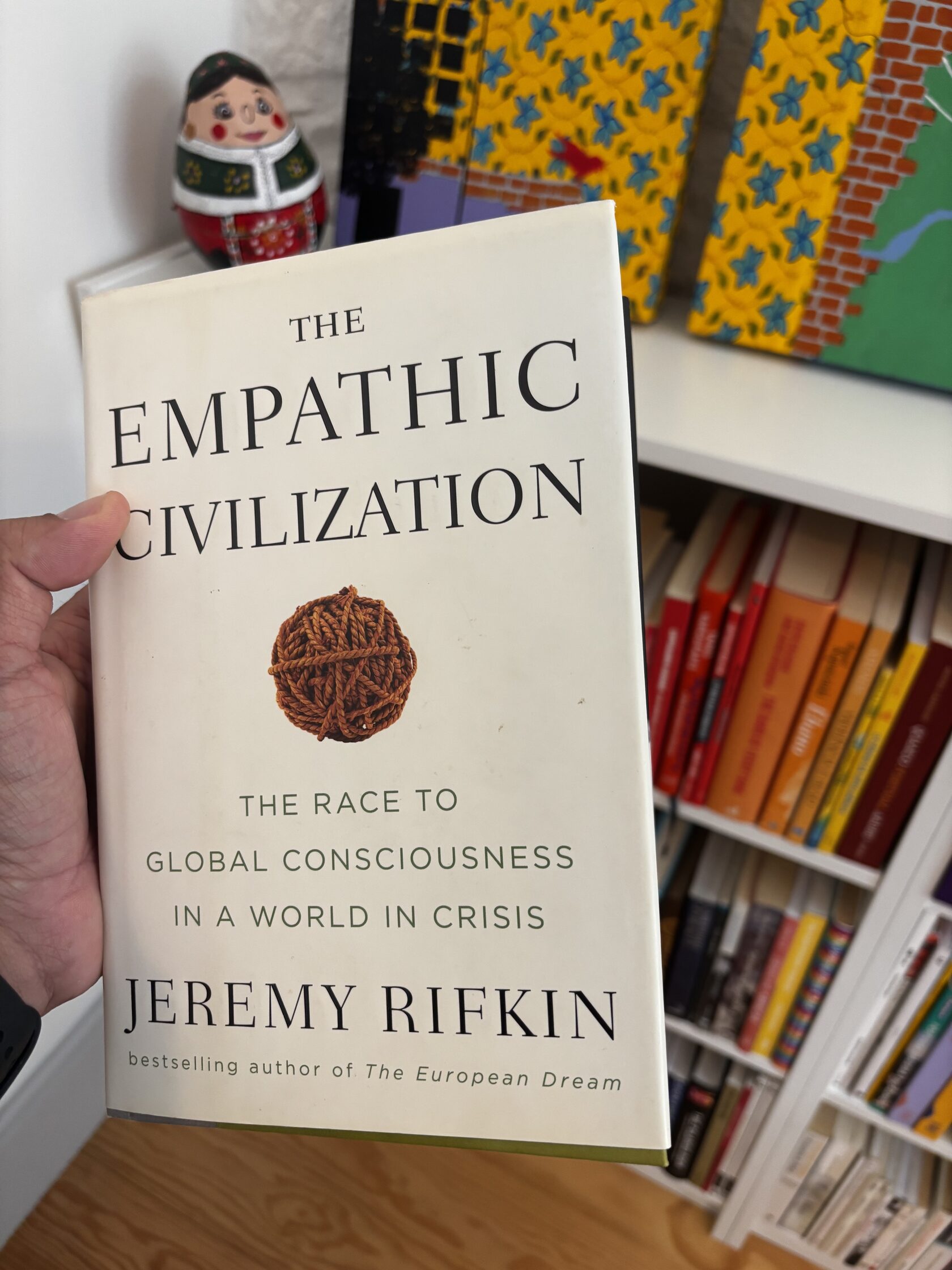
Two friends sent me the same thing yesterday: Pope Leo XIV’s new encyclical on the human person in the age of AI: Magnifica Humanitas [which means something like “Magnificent Humanity” in Latin]. It pulled a book off my shelf I hadn’t opened since 2010, Jeremy Rifkin’s The Empathic Civilization [his TED talk may be the TL;DR; one needs] read in the middle of the last crisis. The two have been arguing in my head ever since.
Here’s the fight. Rifkin says the circle of belonging keeps widening, from tribe to nation to one global ecosphere of species – “us, the life of Earth”.
The Empathic Civilization is emerging. A younger generation is fast extending its empathic embrace beyond religious affiliations and national identification to include the whole of humanity and the vast project of life that envelops the Earth.
This was written 16 years ago? Did the civilisation that Rifkin envisioned really arise
Leo’s encyclical asks who owns the medium that draws the circle now. A wider circle you don’t control isn’t a wider us. It’s a bigger audience.
The Circle Keeps Widening
Those who control digital platforms and means of communication have a considerable ability to affect the collective imagination... so that the culture fostered on the internet does not become an instrument of excessive distraction, homogenisation or dominance...
Rifkin calls it empathy. Leo calls it solidarity. I’d call it belonging. Same question, different starting points.
Rifkin’s argument starts with biology. Humans are wired to feel what others feel – the Mirror Neurons. Every time a new communication medium emerged, it further extended that capacity. The spoken word kept empathy inside the tribe. Writing stretched it across time and space. Print built two things at once: the private mind that thinks alone, and the public of strangers reading the same page, imagining one nation.
Each medium widened the circle. Each one also quietly rewrote what a self and a bond were. That’s the part Rifkin skips.
Then the digital run. The PC extended the individual. The internet detached belonging from location and being in the same place. Mobile made the self always on, always tracked, always sharing. It shaped the (Sharing) Economy, they said. Each step widened the circle further. This was Rifkin’s moment: the infrastructure for a circle with no edge.
Then AI, which breaks the pattern.
Every medium before it carried meaning between people. AI sits inside the relationship as a participant. It writes the message, predicts the reply, and stands in as the other. The channel became a counterparty. And someone owns it. Someone capitalising it. Follow the money.
Leo’s encyclical names this precisely. AI can imitate language. It can simulate the surface of empathy.
When the Medium Becomes the Participant
Then AI arrives and breaks the pattern.
Every medium before it carried meaning between people. AI sits inside the relationship as a participant. It writes the message, predicts the reply, and stands in as the other. The channel became a counterparty. And someone owns it. Someone capitalising it. Follow the money.
Leo’s encyclical names this precisely. AI can imitate language. It can simulate the surface of empathy.
They may imitate language, behaviour and analytical skills, or even simulate empathy and understanding, but they do not understand what they produce, for they lack the affective, relational and spiritual perspective through which human beings grow in wisdom
High level service blueprint elements showing how the B2B garage experience breaks down
The orchestration of what mechanics see and do (frontstage), what makes it work (backstage), and the strategic decisions behind it (behind-the-scenes) is what hold the whole garage experience together.
Organisations that can design these elements as a unified whole, ensuring the experience remains cohesive at every touchpoint, are those that will thrive.
What it cannot have is what Rifkin says makes empathy real: a body that ages, a life that ends, the weight of actual suffering. A system that processes your grief without feeling any of it isn’t an empathic participant. It’s a very good mirror.
The Cost of Outsourcing Belonging
Here’s the cost. Every old medium made you reach for another mind. That reaching is the muscle Rifkin calls empathy. AI is the first medium that does the reaching for you. A muscle you stop using is a muscle you lose.
You lose.
Power was used to sit in the land and factories. State either owned, or regulated them, or both. Now it sits in algorithms, platforms, and data, held by very few. Who gets seen and how we relate no longer belong to the state. They belong to the platform. And the platform belongs to a technology company, which belongs to one of the very few tech-bro billionaires.
They win.
Rifkin measured how far the circle travelled. Leo named who owns the pen.
Rifkin’s word is empathy: the act of reaching and connecting with another living being and mind. Leo’s is solidarity: recognising yourself in the fate of others. Solidarity as a direct alternative to the "isolation and optimisation" often driven by AI. I’m using belonging because it names what’s actually at stake: whether the people inside the circle recognise and reach out to each other, or have just been allocated to doom scrolling the same feed.
Rifkin’s deepest claim is that empathy requires what a feed can never simulate: shared mortality, a body that ages, a life that ends. Without that weight, belonging is replaced by synchronised isolation: the same content consumed in separate worlds. The two are hard to tell apart. The medium is optimised to monetise people who mistake a simulation for a soul.
Outsource belonging to something that cannot feel it, and you don’t end up expanding the circle. You end up as a data point in a cold system that does not weep and does not repent.
Not a circle. A feed.
AI disclosure: The accompanying illustration was generated using Gemini AI. AI was also used to support the outlining and editing of this post. The final content and revisions are my own.