Two things on my feed this week that, together, tell a story most AI discourse is missing.
👨🏻💻 Andy Budd on
design leadership in the age of AI: the production layer is being compressed. Designers who think in systems and redesign processes (not just UI) will be the ones who matter. He gives design leaders a 6-month window to define the narrative before execs define it for them.
Lenny Rachitsky 's
takeaways from
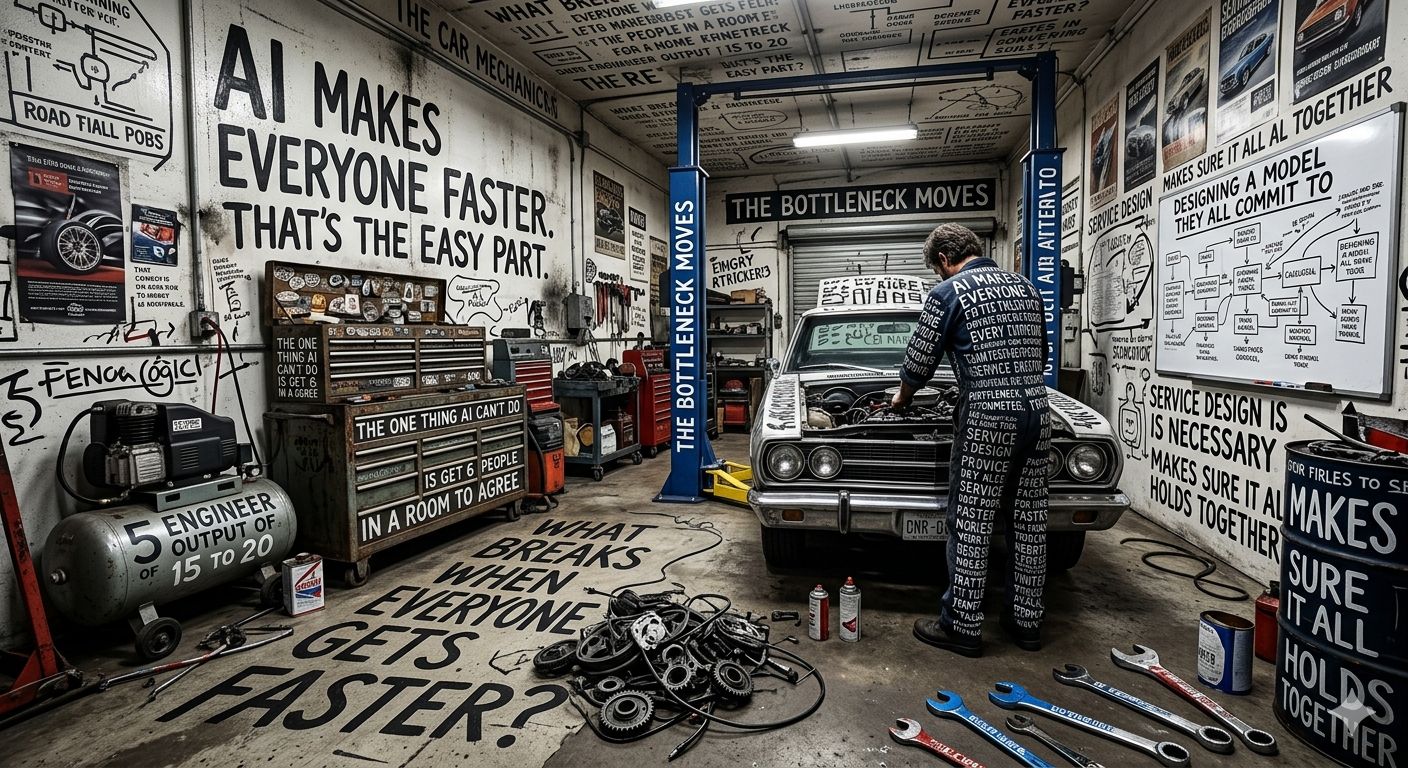
Amol Avasare, Anthropic’s Head of Growth: a 5-engineer team now produces the output of 15 to 20. But PM and design productivity haven't kept up. And Anthropic's response? Hiring more PMs, not fewer. Because the one thing AI can't do, in Amol's words: "is get 6 people in a room to agree".
But the challenge was never just speed-to-output, but decisions' quality that shapes what is built.
Reading these together a pattern emerges.
The entire product org, not just design, PMs, tech leads, engineers can speed up execution. Everyone ships faster. But faster execution without coordination doesn't produce better products. It produces more stuff that doesn't connect.
The bottleneck moves:
I see this every day.
I've led the design of an after-sales process in B2B automotive. Five functions, each with KPIs that literally contradict the others. The customer wants fast reimbursement. The back office wants thorough verification. The field team needs to maintain the relationship while flagging issues they can't judge. The supplier wants full documentation before paying. And finance needs to close a deficit where the company pays out more than it recovers.
AI can generate outputs for any of those perspectives in minutes. What it can't do is help 5 people realise they're solving different problems and design a model they all commit to.
That's The Work. Not the artefact. The conditions for the artefact to make sense.
Budd calls these designers "Navy SEAL units." Avasare calls this "the part AI can't automate." I call it Tuesday.
There's a name for this discipline. It connects what customers experience with what happens backstage and the decisions behind both. It redesigns processes, not screens. It governs coherence across squads that would otherwise optimise in isolation.
While AI makes everyone faster at doing, the need for someone who makes sure it all connects goes up, not down.
Carlos Costa Moreira flagged this to me months ago. He's usually right.
So here's my question to design and product leaders:
Your org is about to get significantly faster at execution. Who's responsible for making sure it all holds together?
If you don't have a good answer, that's the gap.