The work your best people do is invisible to your own metrics. This article aims at explaining why.
Most organisations measure what their design, research and product teams ship. Features. Screens. Flows. Tickets closed. Then they ask why the value of the design function is so hard to pin down.
The value is hard to pin down because the measurement system was never built to see it. This is not a communication problem, and it will not be fixed by a better deck, more logical OKRs or another round of "educating stakeholders". It is structural, and Stafford Beer described the structure fifty years ago and Ricardo Martins recalled me about it, this week. Obrigado!
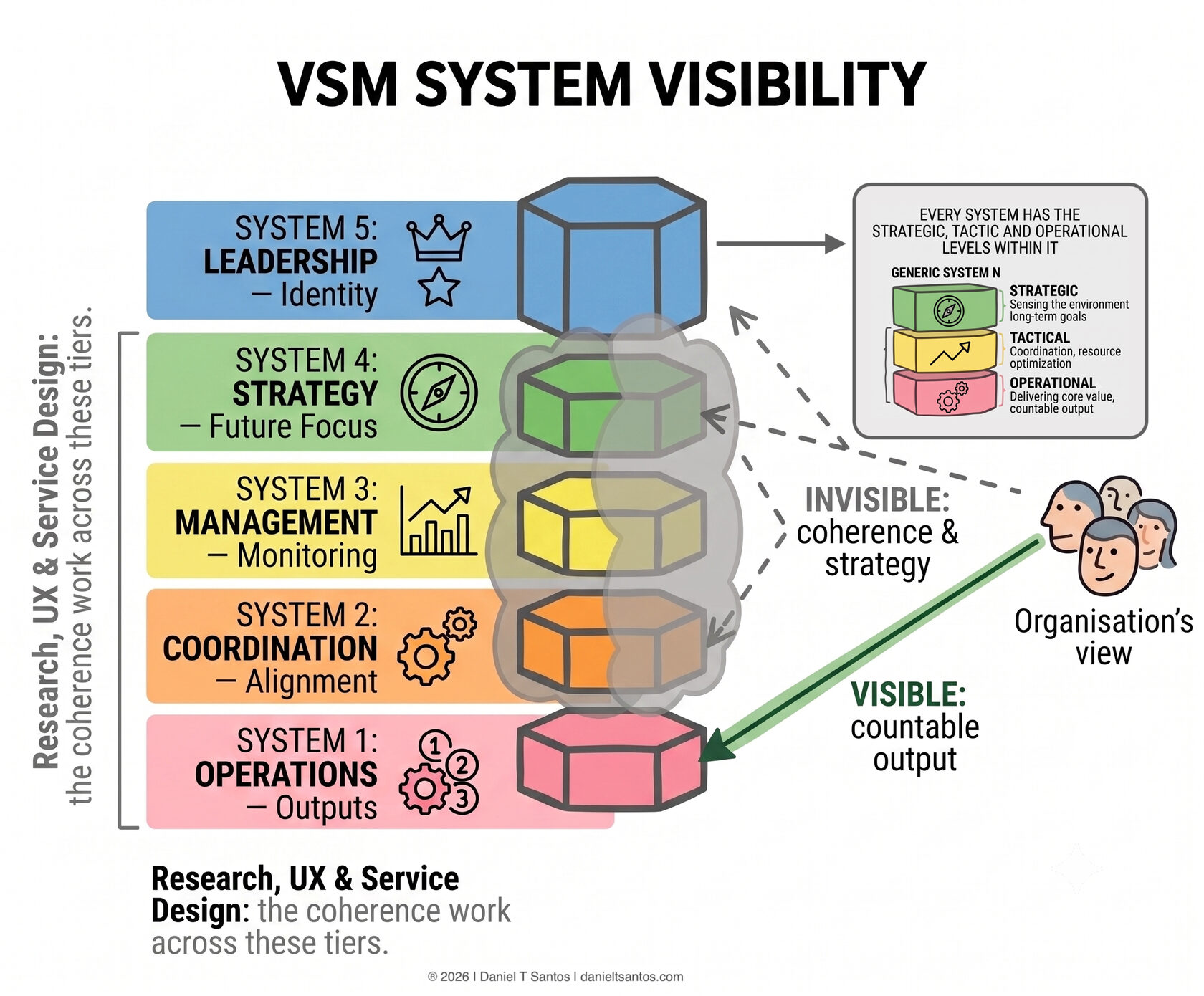
VSM's visibility: the organisation counts System 1 output and misses the coherence work in the tiers above it.
Two kinds of work, one kind of measurement
Beer's Viable System Model splits any organisation into five interacting systems. Two of them matter here.
System 1 is operations: these are the units that produce the countable output. The screen ships, the order moves, the revenue lands. System 1 is legible by construction, because the organisation was built to count what it produces.
System 4 is strategy and coherence. This is the outward and forward-facing work: sensing the environment, holding coherence across the parts, deciding what the service should become. This is where research that reframes a requirement lives. Where the journey gets held together across channels that each have their own backlog. Where the principles that shape a hundred downstream decisions are set.
System 4 work produces no countable artefact in the quarter it is done. So the organisation, looking through a System 1 lens, does not see it. Peter Merholz recently called this design's legibility gap, and it is worth reading. Beer gives it a mechanism: the work is not illegible because it is done badly or explained poorly. It is illegible because it sits in a tier the measurement system does not read.
Why "help them appreciate it" keeps failing
The usual prescription is to make "the business" appreciate the indeterminate work. Widen the aperture. Help leadership see the craft. Translate the work into stories.
That impulse is understandable, but it runs into the same wall. You cannot ask a measurement system to value what it was not built to see.
Appreciation is not the missing ingredient. A shared unit of account is.
The move that does work: anchor, don’t translate
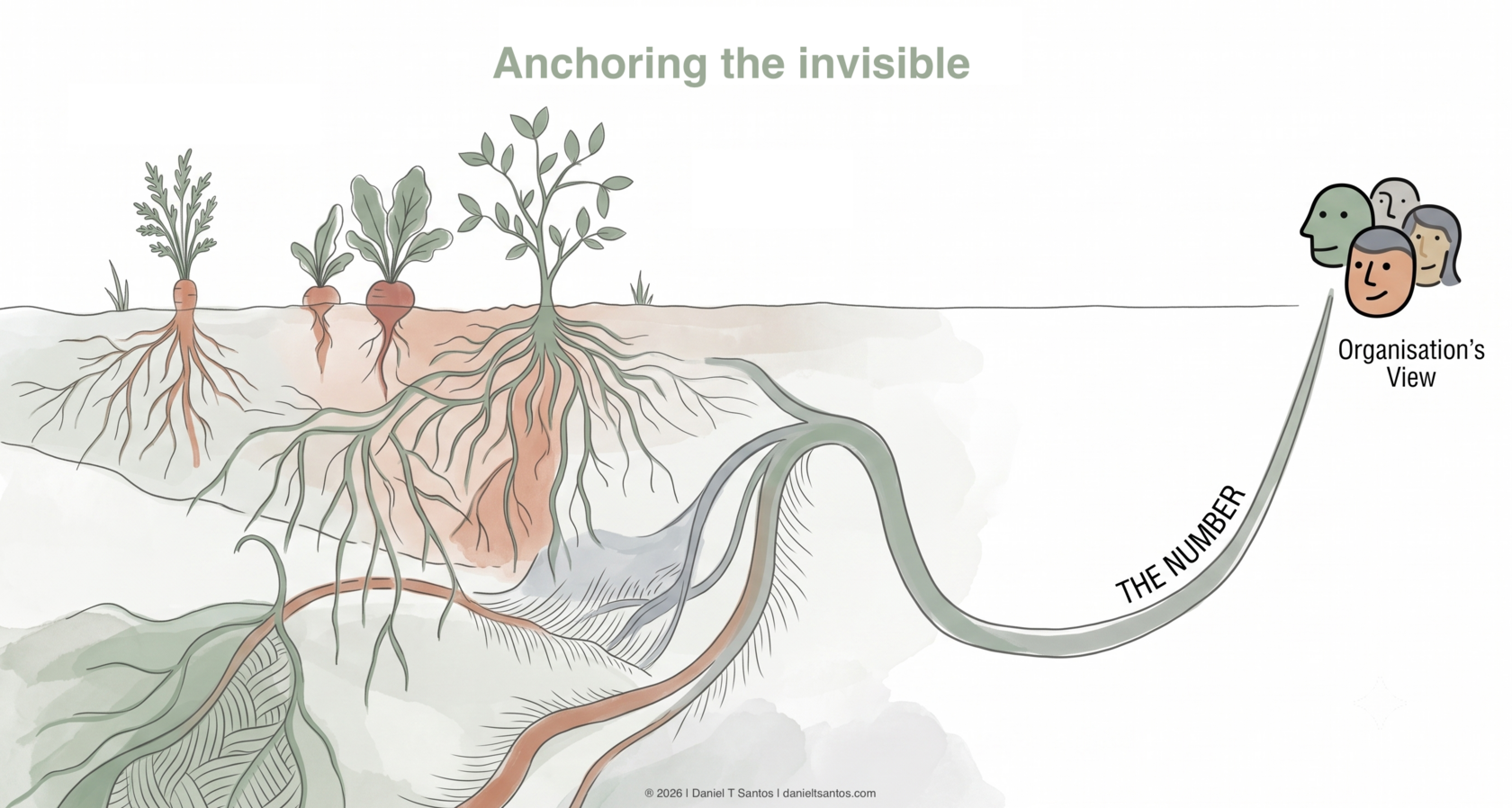
Indeterminate work becomes legible when it is anchored to a number the organisation already counts.
Anchored instead of translated or championed!
You take the System 4 work and you attach it to the System 1 metric it was quietly moving all along. You decide, up front, which existing operational or financial number this work should shift if it succeeds.
In B2B post-sales, where I have spent the last stretch of my work, the anchors are specific and they already exist on someone's dashboard:
Warranty coherence work → claim‑to‑cash cycle time: The days between a claim being made and the garage being paid. Redesign the flow across product, supply chain and field teams or third party partners, and that number moves. No screen change produces it, because the delay lives in the handovers between teams, which is exactly the coherence tier.
Returns coherence work → manual handling per return: Rebuild the physical-and-digital handover and the operational touches per return fall, so does its cost. That reduction is the "phygital" stitch made countable.
Delay coherence work → contact deflection on delayed orders: Close the gap between detecting a delay, notifying the customer, giving them a way to act on it, and the support contacts on delayed orders drop – and so do returns from customers who sourced on‑time alternative parts from local vendors in the meantime.
None of these is a design metric. Each is an operations or finance metric the business was already counting. The coherence work was always moving them. The only change is that you name the anchor before you start, and report against it when you finish.
Why structure and scale make the gap worse
Beer's model has one more property worth naming: it repeats at every level. A squad has its own five systems. So does the division. So does the company. It works like a fractal.
That means the invisibility compounds. The coherence work is under-counted at the team level, then again at the division, then again at the top. By the time someone is drawing boxes for a reorg, the function that keeps the service coherent across silos has the weakest quantitative case for its own existence.
That is the real cost of the legibility gap. A recurring, structural under-valuation of the work that keeps a service or a product coherent, amplified every time the organisation reorganises around what it can count.
The number is never the whole story. Anchor it anyway.
There's a tension here worth naming. Dr. W. Edwards Deming argued that many of the figures that really matter for managing an organisation are "unknown and unknowable," and that managing by visible numbers alone is a disease, not a discipline. A metric never captures what coherence work is really worth.
The most important figures needed for management of any organisation are unknown and unknowable – Dr. W. Edwards Deming
However the organisation manages by visible numbers regardless. That is the culture you are inside, not one you can argue your way out of. So anchoring the work to a number it already moves is not a claim that the number equals the value. It is the decision you make to get the work counted at all. The work is worth more than the metric. The metric is just how it gets seen.
The move: anchoring work to a number the organisation already views
That is the whole move. Not to argue for the work, or to ask the business to appreciate it. Find the number it was already moving, name that number before anyone asks, and report against it when the work is done.
AI disclosure: The accompanying illustration was generated using Gemini AI. AI was also used to support the outlining and editing of this post. The final content and revisions are my own.